
the broader NSE Nifty settled 114.90 points, or 0.96 per cent, higher at 12,086.70. Axis Bank was the top gainer in the Sensex pack, rallying 4.21 per cent, followed by Vedanta 3.75 per cent, SBI 3.39 per cent, Maruti 3.20 per cent, IndusInd Bank 3.07 per cent and Yes Bank 2.87 per cent. Bharti Airtel slipped 1.98 per cent, Kotak Bank 1.38 per cent, Bajaj Auto 0.88 per cent, Asian Paints 0.31 per cent, HDFC Bank 0.05 per cent and HUL 0.03 per cent.
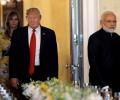
'China was the elephant in the Oval Office and Trump would have sensed that Modi's foreign policy architecture has become disoriented sans the US' pivot to Asia,' points out Ambassador M K Bhadrakumar.

'Clearly, from the Indian viewpoint, the US retrenchment from Asia cannot be happening as good news.' 'The abandonment of the US' pivot to Asia exposes the US-Indian partnership to be a mere transactional relationship,' says Ambassador M K Bhadrakumar

The market last tumbled 10% or more in December 2016 following demonetisation. The decline was followed by a sharp rebound. This time the chances of such a v-shaped recovery are less.

The Department of Commerce alleged that Huawei was engaged in activities that are contrary to US national security or foreign policy interest.

India looks less equal to China than 5 years ago, the strategic alliance with the US is hobbled by trade, and Pakistan is looking anything but chastened by Balakot. What has gone wrong? asks Shekhar Gupta.

The NSE Nifty, which dipped below the key 10,800-mark to touch a low of 10,755.40, bounced back on late buying to close at 10,817.70, up 9.65 points, or 0.09 per cent.
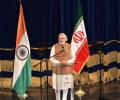
The Modi government caved in under American pressure without even token resistance. Two countries similarly placed as India with high dependence on Iranian oil -- China and Turkey -- have shown the grit to stand up to Washington, says Ambassador M K Bhadrakumar.

'China was a relationship from which Mr Modi had expected the most it seems.' 'It showed in a string of summits, and somewhat breathless celebration of Xi Jinping.' 'It was hasty and simplistic,' observes Shekhar Gupta.

Banking stocks led by SBI, ICICI Bank, Bank of Baroda, PNB, Kotak Bank, HDFC Bank, Axis Bank, Federal Bank and Yes Bank fell as much as 2.77 per cent.

A substantial fluctuation is likely because for a long period gold has moved in a narrow range of $ 50-60 and at higher levels short positions were built.

'So far as supervision is concerned, there are enough powers but to take action on public sector banks, consultation with the government is needed.'
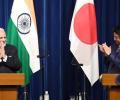
'Relations between India and Japan are robust and devoid of either shadow of history or any irritant.' 'In fact, there is plenty of warmth and goodwill earned over history. There are no negatives but only opportunities,' notes Dr Rajaram Panda.

The ballooning of crude prices has significantly increased the country's oil import bill and it can also lead to a worsening of the current account deficit and fiscal deficit for the domestic economy.

A realistic assessment will tell us that not much has changed between India and Pakistan; the relationship remains as fraught as before with little prospect of reconciliation, notes Ajai Shukla.

The NSE Nifty ended 89.40 points, or 0.83 per cent, lower at 10,710.45.
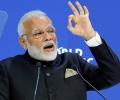
Hard selling India as an investment destination at the WEF, Modi said the government is following the principle of reform, perform and transform.

In the Sensex pack, ICICI Bank emerged as the top gainer by rising 0.97 per cent, while Tata Steel advanced 0.92 per cent.

Overall forex market sentiment suffered a sudden reversal of fortune contrary to expectation largely moving in line with local equities, reversing all early strong gains.

'An isolationist US and a disintegrating European Union will create a power vacuum that only China is in a position to fill -- a conclusion that is uncomfortable but unavoidable,' says Nitin Desai.
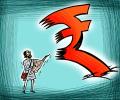
Barry Eichengreen, professor of economics and political science, University of California, Berkeley, analyzes the transparency of the Reserve Bank of India, the growth rate of the Indian economy and why he feels globalisation can never be rolled back.

An increasing number of US lawmakers voiced anger on Monday over the NBA's response to a Houston Rockets official's tweet backing Hong Kong democracy protests, raising US-China tensions as talks to end a 15-month trade war resumed.

Despite the headwinds both on the domestic and global fronts, Ramesh S Damani, member, BSE and a prominent investor, says India will weather a global trade war better than a lot of other Asian countries.

Market experts on why the bulls will be on the rampage first thing on Monday after the scrapping of enhanced surcharge on FPIs and other measures to ease the systemic liquidity squeeze and boost demand. Prasanna D Zore reports.

Year 2017 will be a benign year for FII flows into India feels Akash Singhania, deputy chief investment officer, DHFL Pramerica Asset Managers.
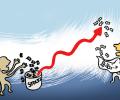
While enjoying long-awaited economic good times - and hoping they will last as long as possible - some caution and some prudence might be the best protection against bad surprises, says Claude Smadja.

Pulwama must become the defining moment in our fight against terror, effecting a sea change in our mindset. The erratic, blow hot blow cold approach, the hallmark of our anti-terror-Pak-Kashmir policy must end. In its place is required a pragmatic, comprehensive, robust hard line course that is relentlessly pursued even in times of relative calm until the final objective is met, namely the eradication of separatism and the total annihilation of terror, says Vivek Gumaste.

A glance back at some important events that occurred in 2018.

The following is the full text of US President Donald Trump's first address to a joint session of the Congress on February 28, as prepared for delivery and released by the White House press office.
 © 2026 Rediff.com - Advertise with us - Disclaimer - Privacy Policy - Sitemap - Feedback - About us - Terms of use - Grievances